Complementary use of two-photon absorption (TPA) and particle SEE testing
SEE testing of microelectronic devices is complex, and multiple methods may be needed to optimize measurements and obtain accurate error rates. The particle SEE testing method and the laser pulse testing method are the two prominent methods of SEE testing, but neither is perfect on its own. Here are some of the drawbacks of each method:
Particle method:
- The broad-beam particle method will stimulate multiple modes simultaneously, and cross-contamination between them is a problem.
- There is no spatial nor any temporal information about the origin of the error.
- For devices with a flipped chip package, the ion beam cannot penetrate the thick dielectric layer to reach the device's sensitive volume.
- The long read-out time will not allow one to determine when the error occurred or what state the memory was in at that time.
Laser pulse method:
- The optical pulse does not penetrate through the metal. Some micro-electronic devices are covered with metal parts, which could cause a problem.
- For two-photon absorption (TPA), as described in an earlier technote, variations in device uniformity or laser irradiance can significantly alter the deposited charge due to the square dependence on laser pulse intensity.
- Although laser-pulse testing identifies the sensitive nodes, it will not provide an accurate measure of error rates.
For the above reasons, laser pulse testing in tandem with particle testing is recommended as a complementary SEE test to identify sensitive nodes, possible modes of error, and obtain an accurate error rate.
To further analyze the properties of these two complementary testing techniques, SEE testing using a TPA method followed by heavy-ion testing is considered for an SDRAM device [Reference 1]. TPA was chosen for testing this device because the top part was covered in metal. The TPA laser beam could penetrate the device through the backside of the device, which had flip-chip packaging, and illuminate the memory cells. Figure 1 shows the schematic of the TPA testing. The microscope objective focused the beam to a diameter of about 1 micron and passed through the transparent, protective dielectric, with no charge generation in the protective dielectric, since the laser wavelength was longer than the maximum possible wavelength for an electron to traverse the silicon bandgap (1.26 microns).

Figure 1: TPA testing of SDRAM
The laser beam produces charge carriers only at its focus when the beam intensity is at its maximum. The micron-sized beam interrogates sensitive nodes of the circuit and eliminates the possibility of cross-contamination of modes that occurs during particle testing. In Figure 2, the microscope objective that focuses the beam onto the part of the circuit with flip-chip packaging is shown.

Figure 2: Microscope objective focuses the laser beam on the SDRAM circuit
Due to the dependence of TPA’s cross section on the square of irradiance, any inhomogeneity on the back side of the Device Under Test (DUT) and also changes in the laser irradiance drastically change the charge delivered to the sensitive volume, and this makes it very difficult to evaluate the equivalent Linear Energy Transfer (LET) for the laser beam. For this reason, particle testing is necessary to provide cross-section vs LET curves for calculating the error rates. Figure 3 shows the cross-section vs pulse energy curve and also the equivalent cross-section vs. LET curve.
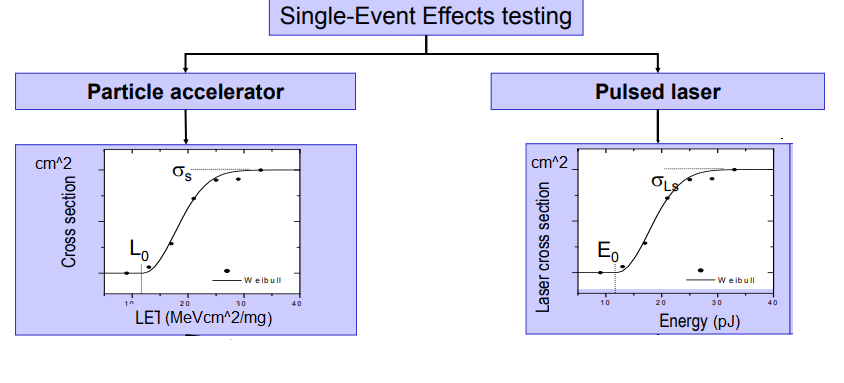
Figure 3: Comparison of pulsed laser and particle method cross-section vs. LET curves
In the figure above, σLS, E0. σs and L0 represent laser saturation cross section, laser SEE threshold energy, particle saturation cross section, and particle SEE threshold energy, respectively.
For the SDRAM test, the Device Under Test (DUT) was placed exactly underneath the camera system and the laser beam. Both the IR beam from the illuminator and the laser beam were focused on the sensitive volume. As the translation stage was driven by the laser beam, the device under test was scanned, and the DUT image was observed by the IR camera. A strip along the center part of the SDRAM contained most of the control logic, and its features were resolvable under the microscope as shown in Figure 4A strip along the center part of the SDRAM contained most of the control logic, and its features were resolvable under the microscope as shown in Figure 4.

Figure 4: The resolved comb-like structure at the center of the SDRAM, which is observed in the picture, contained most of the control logic and caused most of the logic errors.
However, the memory array was located on either side of this strip down the center of the SDRAM, and the microscope's resolution (nearly 1 micron) was not high enough to resolve its features, as depicted in Figure 5.

Figure 5: The resolution of the microscope was not high enough to resolve the individual memory cells
The types of errors that were observed during these tests were
- SEU (Single Effect Upset), where the state of a bit was reversed
- Minor logic errors, causing 20 upsets
- Block errors, causing up to 20-4096 upsets
- SEFI (Single Effect Functional Interrupt), which required a power cycle for recovery
The TPA testing influenced the heavy ion testing. The main goals of heavy ion testing were to identify SEFI vulnerability, compare the error modes induced in laser and heavy ion testing, and determine cross-section vs. LET curves for different error modes, such as SEU, SEL, and SEFI. One predetermined strategy for the heavy-ion testing was to mask parts of the logic circuit to separate logic circuit errors from memory cell errors. However, the laser testing showed that the control logic is also scattered across the memory array, and therefore, this masking strategy will not be effective.
Several heavy ions were used during the heavy ion testing, including Ne, Ar, Kr, and Xe beams, but a SEFI error could only be observed once during a Kr heavy ion test. The LET for this Kr ion beam was about 22 MeV cm²/mg, and its symptoms of this error mode were very similar to those of laser pulse testing. It required a system reboot to clear, and this error mode likely occurred only during a small part of the SDRAM's operation.
In conclusion, TPA laser testing can be a highly effective tool for evaluating a system's SEE response before heavy-ion testing. Inducing and observing the occurrence of different error modes using the laser-pulse testing method elucidates what to expect during heavy-ion testing, and preparation can be made for test methods, hardware, software, and analysis before a trip to a heavy-ion testing facility.
Allied Scientific Pro has designed a pulsed laser-based SEE testing SPA system that can be upgraded to a TPA system. A video of the system can be found at the following link:
https://photos.app.goo.gl /qRxrgvGaDejq416V8
Reference: R. Ladbury et al, TPA laser and Heavy ion SEE testing: Complementary techniques for SDRAM Single Event Evaluation, IEEE Transactions on Nuclear Science (TNS), December 2009.