Traditionally, in the food industry, cleaning and disinfection are performed using detergents and water. Bacteria on surfaces form biofilms that adhere very strongly [Reference 1]. Studies have shown that these biofilms are difficult to remove with detergent solutions because they are sticky. Bacteria are easier to remove from liquid solutions than from the surfaces of solids such as stainless steel. Biofilms tend to resist removal by mechanical and chemical means. Other disinfection methods need to be explored to replace mechanical scribing and chemical methods. Figure 1 shows a stainless steel surface infected with bacteria.
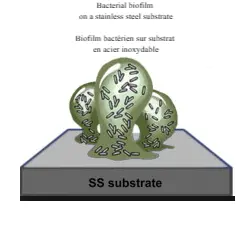
Figure 1: Stainless steel surface infected with bacteria
Laser cleaning of surfaces infected with bacteria is a very effective method because the laser's thermal effects can disinfect the surface. Figure 2 shows laser cleaning of a contaminated tray.
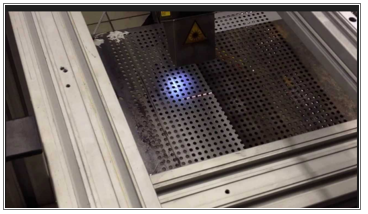
Figure 2: Laser cleaning of a contaminated tray
Studies have been conducted to evaluate the effectiveness of different types of lasers for cleaning bacteria-contaminated surfaces. Pulsed lasers are usually used, but the choice of wavelength, pulse energy, and repetition rate is essential. In one study [Reference 2], seven different types of lasers, ranging from Ultraviolet (355 nm) to far IR (118 μm), were used to assess their effectiveness in killing Escherichia coli (E. coli) bacteria. Among the lasers, a CO2 pulsed laser at 10.6 μm and several Nd:YAG lasers operating at nominal, second-harmonic, and third-harmonic wavelengths were used.
The study showed that the CO2 pulsed laser was the most effective at removing bacteria, followed by the Nd:YAG laser at a specific energy density. The effect of UV on killing bacteria is well known, and the third most effective laser was the frequency-tripled Nd:YAG laser (355 nm emission). For testing purposes, E. coli was plated onto several plates, which were then irradiated with a laser. After this exposure, the plates were incubated for 24 hours at 37°. If laser sterilization worked, after growth, an area free of bacteria would be observed. Table 1 shows the different laser parameters and the observed area free of bacteria after exposure to these lasers.
| Laser | Wavelength (μm) | Beam area (cm2) | Mean power (watts) | Exposure time (sec) | Energy density (J cm-2) | Area of bacterial killing (cm2) |
| CO2 | 10.6 | 2.3 | 600 | 0.03 | 7.88 | 1.21 |
| Nd:YAG Lumonics | 1.06 | 1.65 | 200 | 16 | 1940 | 0.715 |
Nd: YAG MInilite 10 Tripled | 0.355 | 0.283 | 0.04 | 60 | 8.49 | 0.0365 |
Nd: YAG Surelite II-10 tripled | 0.355 | 0.283 | 1 | 3 | 10.6 | 0.123 |
Table 1: Comparison of lasers for decontamination of bacteria-infected surfaces [Ref 2]
As shown in the table above, the energy density of the Lumonics Nd:YAG laser (10-msec pulses with 10 Joules of energy at 20 Hz) was 246 times that of the CO2 laser, and the exposure time was 533 times longer. This difference could be attributed to the fact that water absorbs the mid-IR radiation (at 10.6 μm) much strongly than the near IR (1.06 μm), and since the E. coli bacteria reside in water, they get killed more easily.
The 355 nm UV wavelength also responded well to sterilization, as shown in the table. The frequency-tripled lasers operated at a 10 Hz repetition rate and had a pulse duration of about 5 nsec. Comparing the Surlite frequency tripled laser with the Lumonics Nd:YAG laser, one can see that with a mean power 200 time smaller and an exposure time of nearly 5 time shorter (Energy density was almost 20 times less), the Surlite laser achieved the same order of magnitude cleaning area as compared to Nd: YAG (0.123 cm2 as compared to 0.715 cm2).
Aside from the effective lasers that killed the E. coli bacteria, others were ineffective. Some of these lasers included a far-IR laser at 118 μm, a diode laser at 0.81 μm, and an argon-ion laser at 0.488 μm. Several different energy densities were used for these lasers, but they proved ineffective at killing bacteria on the surfaces.
Allied Scientific Pro has developed a fiber based laser cleaning system that has already been used and proved itself working in many different fields such as ruch removal in aviation industry, cleaning historical monuments and decontamination of a nuclear facility. These laser cleaning systems have a laser head, optics, and galvo mirrors that can make different-shaped beams. Typically, a linear beam is used, but to extend the application of these laser cleaning systems to surfaces infected with bacteria and to increase the beam's energy density, a circular spot size can be generated. As for the repetition rate and mean power, the specifications are compatible with the parameters of the Nd:YAG laser from Lumonics listed in Table 1.
Figure 4 shows the laser cleaning system by Allied Scientific Pro. This is a 100 Watt system operating at 1030 nm wavelength called Laser Blast 100.
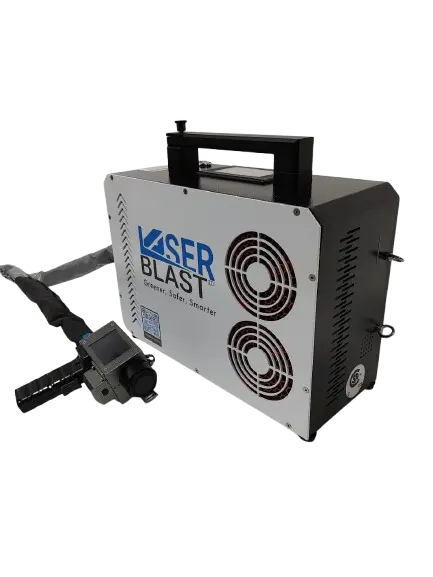
Figure 4: Laser blast 100 system by Allied Scientific Pro
Cleaning operations for contaminated metal surfaces in the food industry could greatly benefit from a laser cleaning system such as the one shown above. It is much faster and more effective than traditional mechanical and chemical methodmechanical and chemical methods.
Visit our dedicated website on Laser Cleaning Machines to learn more
References:
- Elimination of adhering bacteria from surfaces by pulsed laser beams, A.K.Sadoudi, et. Al, Letters in Applied Microbiology 1997, 24, 177-179, 1996.
- Comparative bacterial activities of lasers operating at seven different wavelengths, I.A. Watson et.al, Journal of biomedical optics 1(4), 466-472 ( October 1996)