With the scarcity of crude oil supplies these days, reflected in the sharp increase in gas prices, it is increasingly important to improve the quality control of the existing crude oil supplies. The composition of crude oil varies with natural origin, transport, and storage conditions (Reference 1). Physico-chemical properties of crude oil that are of importance are specific gravity (also called API gravity), actual boiling point curve, and viscosity (Reference 1). API gravity is short for American Petroleum Institute gravity, which is an inverse measure of the weight of petroleum liquids in comparison to water. If a liquid has an API gravity greater than 10, it is considered a light oil that floats on water.
Analytical methods for crude oil quality control are time-consuming, expensive, and require sample preparation. Near-IR Spectroscopy (NIRS) is a rapid, inexpensive method that does not require sample preparation and can be used for in situ measurements of crude oil’s physicochemical properties. Bonds such as CH, NH, and SH are target absorption bonds that NIRS can identify. Figure 1 shows the NIRS spectrum of crude oil in a wide range. Allied Scientific Pro offers T1 and T11 portable near-IR spectrometers with a cuvette that measures a portion of the NIR spectrum, as shown in Figure 1.
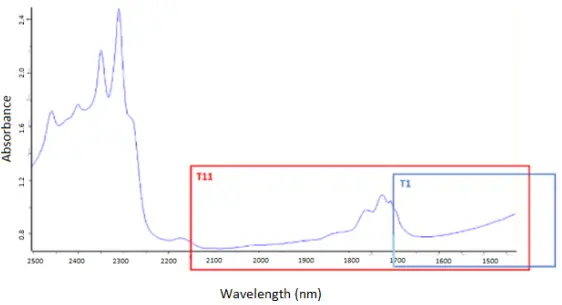
Figure 1: NIRS spectrum of crude oil. The blue and red boxes show the spectral ranges of Allied Scientific Pro’s spectrometers T1 and T11.
For more information about these transmittance spectrometers, please refer to https://www.alliedscientificpro.com/nirvascan.
The sulfur content of crude oil is also quite essential to quantify, as downstream processes such as catalytic cracking and refining are adversely affected by high sulfur content. Catalytic cracking is a vital process in the oil industry, where petroleum vapour passes through a low-density bed of catalyst, which cracks the heavier fractions and produces lighter, more valuable productin the oil industry, where petroleum vapour passes through a low-density bed of catalyst, which cracks the heavier fractions and produces lighter, more valuable products. The sulfhydryl group represented by the SH bond shown in Figure 2 can be detected by a near-IR spectrometer at 1750 nm.
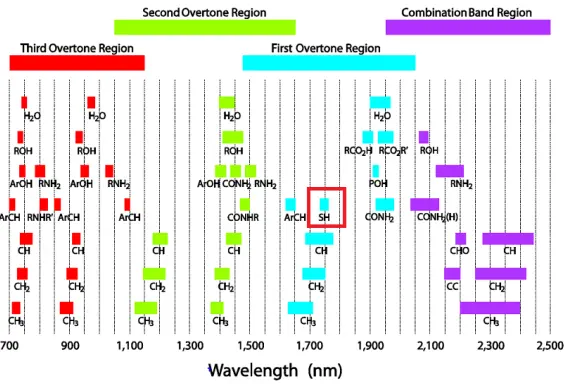
Figure 2: Sulfhydryl group (SH bond) can be detected using the T11 spectrometer at 1750
Partial Least Squares modelling was used in a study to model 153 crude oil samples (Reference 1). The first derivative and the Savitzky-Golay (SG) filter were applied to the collected data, and predictions were made for 30 spectra in a test set, which were subjected to the exact first derivative and SG filter. The API range for the samples was 20-43°, and the sulfur content was 0.3-3.8%. nm. The PLS regression model achieved accuracies of 2.73% for API gravity and 4.46% for sulfur content, which are reasonable.
In another study conducted at Allied Scientific Pro, several crude oil samples were supplied for testing with the T1 spectrometer, which has a range of 900-1700 nm. The samples were all sealed and appeared to have varying viscosities. Because crude oil samples are generally very viscous and dark, a standard 1 cm cuvette for a transmittance spectrometer is not suitable for measuring their transmission. For this reason, a 1 mm-thick cuvette was provided. Figure 3 shows the crude oil sample in a 1 mm thick cuvette.
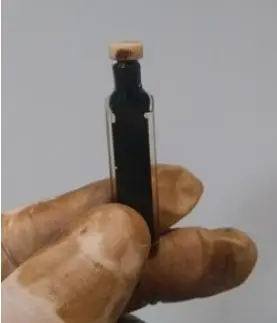
Figure 3: Crude oil sample in a 1 mm thick cuvette
The cuvette was placed in the transmittance spectrometer, as shown in Figure 2, and its transmission over the range 900-1700 was measured.
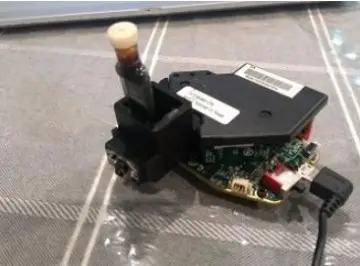
Figure 4: A 1 mm cuvette filled with crude oil was placed inside the cuvette holder of the T1 spectrometer
Several samples were tested, and their absorption plot is shown in Figure 5.
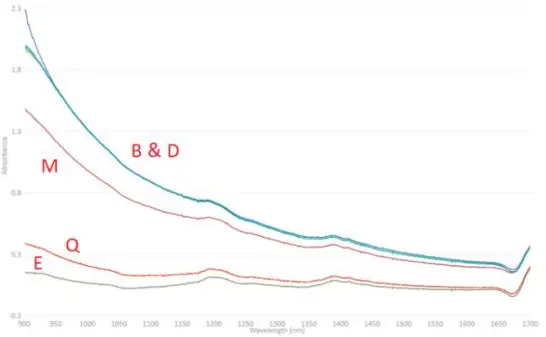
Figure 5: The absorption plots of crude oil samples
Although this was a qualitative study and no PLS modelling was performed on these samples, it was observed that the more viscous samples showed a sharp rise in absorption at short wavelengths in the absorption plot. The viscous nature of the samples was assessed visually during pouring into the cuvette, based on the residual adhesion to the cuvette after removal.
In conclusion, handheld NIR spectrometers are ideal devices for field testing of crude oil products and can provide information on crude oil's physicochemical properties. Allied Scientific Pro also offers the Nirvacloud platform, where users can upload their spectral profiles, do pre-processing, and create Partial Least Squares (PLS) models to quantify ingredients in their crude oil samples.
References:
1 - Rapid crude oil analysis using near-infrared reflectance spectroscopy, J Long et.al, Petroleum Science and Technology, vol 37, no 3, 2019.
2 - Sulfur content. The science of Victorian brown coal, Science Direct, 1991.